Posts

what is thoughts

magazineplush magazineplush magazineplush magazineplush magazineplush magazineplush

Three Laws of Motion - [Newtons 3 Laws of Motion]

Image
At the end of the article, you will able to describe - newtons 3 laws, What are the three laws of motion. Let's start discussing one by one. What are the Three Laws of Motion Sir Isaac Newton (1642-1727) made a systematic study of motion and extended the ideas of Galileo. He arrived at three laws which are called Newton's laws of motion. Newton's first law of motion Newton Second law of motion Newton's Third law of motion Remember Newton's first law is often termed, the law of inertia. Inertia is the property of matter by virtue of which an object continuous in its existing state of rest or uniform motion in a straight line unless an external force changes that state. Note: Mass is the quantitative measure of inertia. Newtons 3 Laws of Motion Born in 1642, the English physicist and philosopher Sir Isaac Newton, revolutionized the world's understanding of the physical universe, with his three laws. Newton's first law of motion Newton's first law of motio...

Types of - [Contact Force, Non-Contact Force (s)] - Examples

Image
We are explaining the interaction between bodies. In this brief article, you'll discover all you need to know about contact force (s), types of contact force with examples, non-contact force (s), and examples. Let's start discussing one by one. Must Read: What is Force with Examples? Contact Force (s) The forces which act on bodies when they are in physical contact. These forces are produced and experienced when a body comes in contact with another body. For example, The force of friction (frictional force) Normal reaction force Force of tension exerted by a string Force exerted by a spring Force exerted on two bodies during collision  etc . When you pushed on an object you are definitely contacting the object directly or indirectly. Types of Contact Forces Frictional Force: When a body slide (or rolls) over a rough surface, a force starts acting on the body in a direction opposite to the motion of the body, along with the surface in contact. This is called the...

Newtons Second Law - What is Newtons 2nd Law of Motion - [Examples]

Image
At the end of the article, you will be able to describe- What is Newtons Second Law -Definition, measurement of the 2nd law of motion, examples of newtons 2nd law. Let's start discussing one by one. Newtons 2nd Law of Motion This fact was first recognized by Newton who expressed it as his second law of motion. A Clue to the second law of motion - Suppose a fixed force is applied on the two bodies of different masses for the same duration. The lighter body gains a higher speed than the heavier one. However, the change in momentum in both cases is found to be the same. This shows that the same force for the same time causes the same change in momentum for bodies of different masses. Must Read: What is Momentum in simple terms? Just now I introduced momentum right. Why did I introduce momentum? it is because momentum played a role in Newton's second law of motion. In second law of motion, Newton basically told that there exists a relationship between force and moving them right....

Momentum: Definition [formula,units,equation,linear momentum,examples]

Image
By the end of this article, you should be able to define Wh at is linear momentum, definition, formula,  units, equation, describe the movement of objects. Let's discuss one by one. What is Momentum- Definition (Linear Momentum) It is the quantity of motion contained in the body.  Here's the key fact, All moving objects have momentum. But if an object is not moving its momentum is zero. Motion in a body can be produced or destroyed by applying force on it. Momentum is denoted by letter "p" Q -  A car has a mass of 1000 kilograms and it is not moving. What is a momentum (p) of the car?  Answer - In this case, the car's not moving and remember the objects that are not moving have a momentum of zero. The force required to start or stop a moving body depends upon. Mass of the Body -   When a ball and a big piece of stone are allowed to fall from the same height, we find that a much greater force is required to stop the big piece of stone than the ball. Thus la...

Newtons third law of motion-[Action,Reaction,Formula,Equation,Examples]

Image
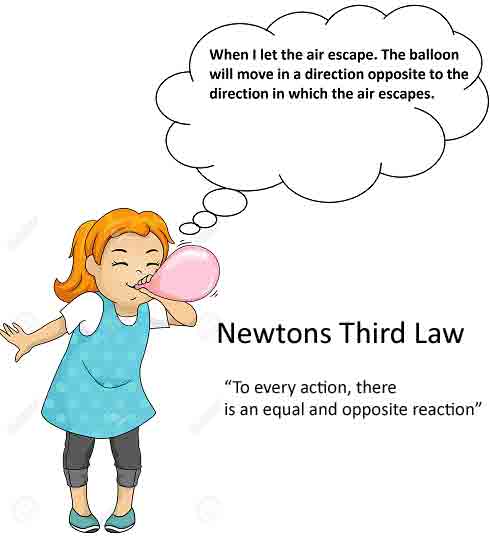
By the end of this article, you should be able to describe what is Newton's third law of motion- Definition, Formula, Equation, action-reaction pair forces and Examples of newtons 3rd law. Let's start discussing one by one. Newton's laws of motion. Sir Isaac Newton (1642-1727) made a systematic study of motion and extended the ideas of Galileo. He arrived at three laws of motion which are called Newton's laws of motion. What is Newtons Third Law - Definition According to Newton's 3rd law of motion, To every action, there is an equal and opposite reaction. Let us explain an activity to understand the law. Take a balloon and tie its mouth to a small piece of plastic tube with a narrow bore. Now inflate the balloon and close the opening of the tube with your finger. Remove the finger and let the air escape. The balloon will move in a direction opposite to the direction in which the air escapes. If we fix the inflated balloon on the top of a toy car. We observe that the...

What is Newton's First Law of Motion- [Definition,Examples, Formula]

Image
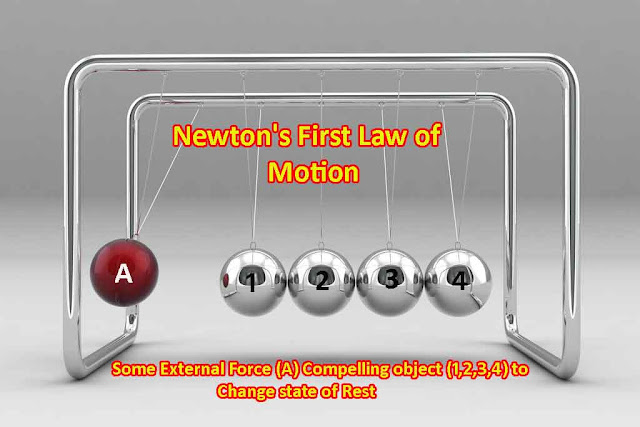
Many a times question arises that what is Newton's first law of motion- Definition, Examples and what is its formula.  Our Today discussion about the newtons first law of motion. Let's start. Newton's laws of motion. Sir Isaac Newton (1642-1727) made a systematic study of motion and extended the ideas of Galileo. He arrived at three laws of motion which are called Newton's laws of motion.  What is Newtons First Law of Motion? This law consists of three parts: First part says that a body at rest continues in its state of rest. An external force has to be applied on it to make it move. A chair lying on the floor will continue to remain there unless we displace it. Second part says that a body in motion continues moving in a straight path with a uniform speed. This part seems to be contrary to our everyday experience. A rolling ball comes to rest on a rough ground. This is because of the force of friction. The ball moves through a larger distance on a smooth floor...

What Is Force-[Definition,Meaning,Examples]-Different Types of Forces And Their Examples

Image
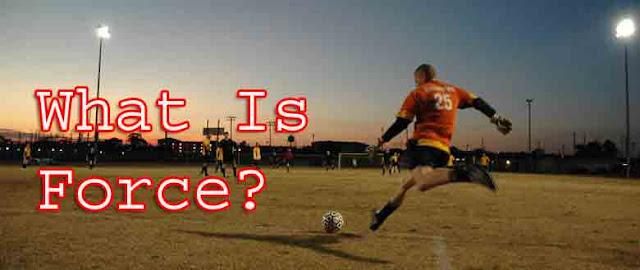
Force-  Mechanics is the branch of physics that deals with the condition of rest or motion of material objects around us. It is one of the oldest branches of physics.The various sub-branches of mechanics in physics are: Static-Study of objects at rest or equilibrium. Kinematics- Deals with the motion of objects without considering the cause of motion. Dynamics- Deals with the motion of objects considering the cause of motion. Our Today discussion about - What Is Force- [Definition, Meaning, Examples] - Different Types of Forces And Their Examples. What Is Force - Definition A force is that physical cause which changes (or tends to change) either the size or shape  or the state of rest or motion of the body. -OR- It  is that cause (condition) which can produce the following two main effects: It can change the state of rest or motion of the body ( i.e., it can produce motion in the body). It can change the size or shape of the body.  ( i.e., it can change ...

What Does Acceleration Mean-Formula,Find, Acceleration,Examples,Difference

Image
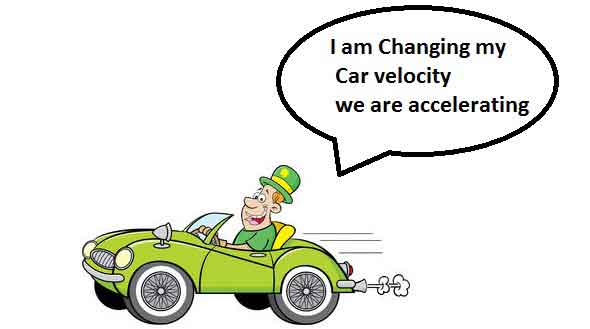
The term acceleration is a part of mechanics. Mechanics is the branch of physics that deals with the condition of rest or motion of material objects around us. It is one of the oldest branches of physics.The various sub-branches of mechanics in physics are: Static-Study of objects at rest or equilibrium. Kinematics- Deals with the motion of objects without considering the cause of motion. Dynamics- Deals with the motion of objects considering the cause of motion. Our Today discussion about the Kinematics. Lets start What Does Acceleration Mean? When moving object changes its velocity (speed in given direction), we use the term in Physics saying that body is accelerating. Object Changes Velocity =  Accelerating Question-  A car is travelling in a straight line at a constant velocity of 80 kilometres an hour. What is its acceleration? Answer- It is zero. It is because velocity is constant.There is no change in velocity. Question- A plane is travelling in a stra...

What is Scalar And Vector Quantity? Difference Between - Examples

Image
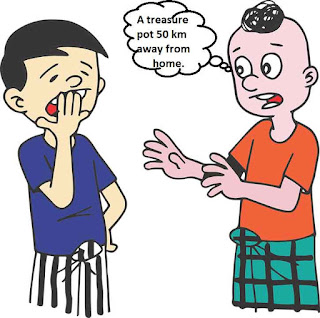
Any quantity that can be measured is a physical quantity. Physical quantities are classified as Vector quantity and Scalar quantity. What is Scalar Quantity? The physical quantities which require the only magnitude for their complete specification are called scalars or scalar quantity. They can be added up based on ordinary rules of algebra. Easy Understanding: If you are standing at a point A. One of your friend tells you that there is a treasure pot 50 kilometers away from home.  How long will you take to find it and in which direction will you go? It could be east, west, south or north. It is hard to know where exactly it is. You are only provided the Distance which is one-dimensional information. One dimensional information like 50 km is called a Scalar Quantity. Your Friend is just telling the distance not the direction. What is Vector Quantity? A quantity which has both magnitude and direction such quantities are referred to as vectors. Easy Understanding: ...

Law of Inertia Science: Definition | What Does Inertia Mean | Examples

Image
Law of Inertia Science: Remember physics is all about how things move and why things move. It was Sir Isaac Newton who discovered the three laws of motion. He was a scientist who lived from 1642 to 1727. Law of Inertia Definition Let's first learn about the first law of motion. It is also called the law of inertia. It states objects will remain at rest or in uniform motion in a straight line unless acted upon by an external unbalanced force. To understand Newton's first law completely. We need to learn about inertia first. What Does Inertia Mean? See a very large sofa what's special about it. It's stable it is not moving. Now go ahead and try to move it. The sofa itself is not willing to move. You can't move it. As it is very large. It means you had to put a huge effort. Now try to move a small stone. You can move it a little bit easier.  It means you had to put a small effort. It was also like it didn't want to move from its original position. Even the sm...

What is Eddy Current? - Applications - Formula- With Experiement

Image
What is Eddy Current? The word Eddie literally means a circular current.  let us now try to understand how they are produced. Take a solenoid that has a soft iron core. Now connect this solenoid to an AC source. When a metallic disc is held over the cross-sectional face of the soft iron core the metallic disc will be thrown into the air. How does this happen? Current flows through the solenoid. Hence, magnetic flux linked with the solenoid increases from zero to finite value.  This change in magnetic flux gives rise to induced currents in the disk. The upper phase of the soft iron core attains the same polarity as the lower phase of the disk. Hence the disk is repelled by the soft iron core and is thrown up in the air. This experiment shows that when a conductor is kept in a changing magnetic field currents are induced in the body of the conductor. These are currents that occur in very small loops and are called eddy currents.  Foucault discovered this concept in 1...

Artificial Satellite- Geostationary,Polar- How are Satellites Launched?

Image
The satellites classified into two types man-made (artificial satellite) and natural satellite. Here our main objective to discuss the artificial satellite, types, and how are satellite launch. What is Artificial Satellite? An artificial satellite is a man-made object orbiting around the earth. Artificial satellites are of two types namely:   geostationary satellites and  polar satellites let us now learn about the launching of artificial satellites and different types of satellites in detail. Geostationary Satellites Geostationary satellites are those satellites whose period of revolution around the earth is equal to the period of rotation of the earth. These satellites appear to be stationary as they revolve around the earth from west to east.  The period of revolution of the satellite is equal to the period of rotation of the earth. They revolve in the equatorial plane the orbits followed by geostationary satellites are called geostationary orbits or parking orbits. ...